Insect investigators
Stage 2 - Science and Technology



Program
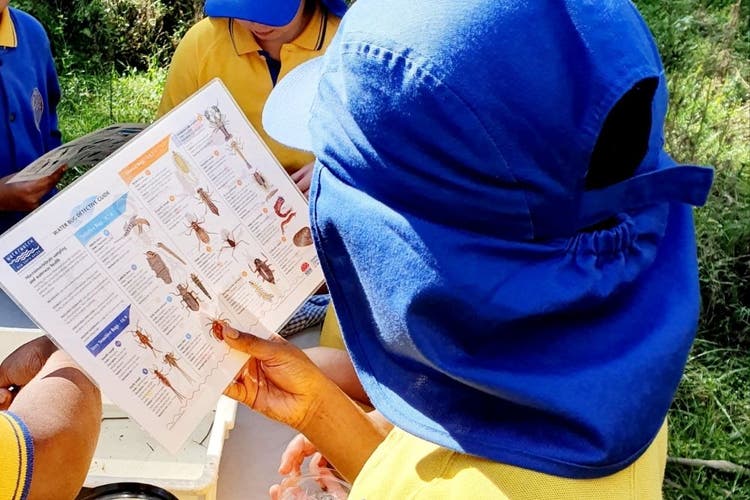
'Insect investigators' is a Stage 2 excursion delivered at Longneck Lagoon Environmental Education Centre. Students explore how living things interact with their environments. They investigate insects in both terrestrial and aquatic habitats, conduct simple scientific tests, and observe the relationships between living and non-living components of ecosystems. Through hands-on fieldwork and food chain activities, they learn how the Earth’s systems support life and how plants and animals depend on each other for survival.
Important information
Science and Technology K-6 syllabus (2024)
ST2-SCI-01
Uses information to investigate the solar system and the effects of energy on living, physical and geological systems
ST2-PQU-01
Poses questions to create fair tests that investigate the effects of energy on living things and physical systems
ST2-DAT-01
Uses and interprets data to describe patterns and relationships
Content
Living things depend on energy and materials to survive
- Identify the systems of Earth that make up environments: air – atmosphere, land – lithosphere, water – hydrosphere, living things – biosphere
- Describe how the needs of living things are provided by the atmosphere, hydrosphere and lithosphere
- Describe the relationship between habitat, ecosystem and environment
- Observe and describe living and non-living things in a habitat
- Describe the transfer of energy between plants and animals using food chains, Tier 2 and Tier 3 vocabulary
- Describe ways in which plants and animals depend on each other for survival
Students will:
-
conduct scientific tests to understand how the needs of insects are met by the atmosphere, hydrosphere and lithosphere in aquatic and terrestrial environments
-
dipnet to collect and learn more about aquatic macroinvertebrates
-
participate in an interactive 'web of life' activity to understand the transfer of energy within an ecosystem and the interdependence of species.
| Vehicle access |
Address: 59 Whitmore Road, Maraylya Large buses/coaches can drop students and teachers at the entrance on Whitmore Road. It is a 400m walk down the drive to the classroom. Bus drop off and pick up should be timed to allow for the walk from the road to the classroom. These times can be negotiated as needed to allow for earlier or later start and finish times. Minibuses and visitors arriving by private car can enter the gates on Whitmore Road and drive part way down the drive to the signposted 'Visitor parking' area near the mud brick shed. It is a short 100m walk from the visitor parking area to the classroom and office area. We kindly ask that visitors do not drive beyond this point in order to ensure the safety of our students. |
| Student numbers |
Up to 3 classes Max. 30 students per class (Please book for multiple dates if numbers exceed 90 students) |
| What to bring |
Students
Teachers
|
| Adverse weather | On days where the weather is unsuitable, a Longneck Lagoon EEC staff member will contact the organising teacher to discuss alternative arrangements. |
| Medical notifications | Notify Longneck Lagoon EEC by completing and returning the student welfare form at least one week before the excursion. This form will be sent out upon confirmation of booking. |
| Further information | Welcome to Longneck Lagoon EEC |